

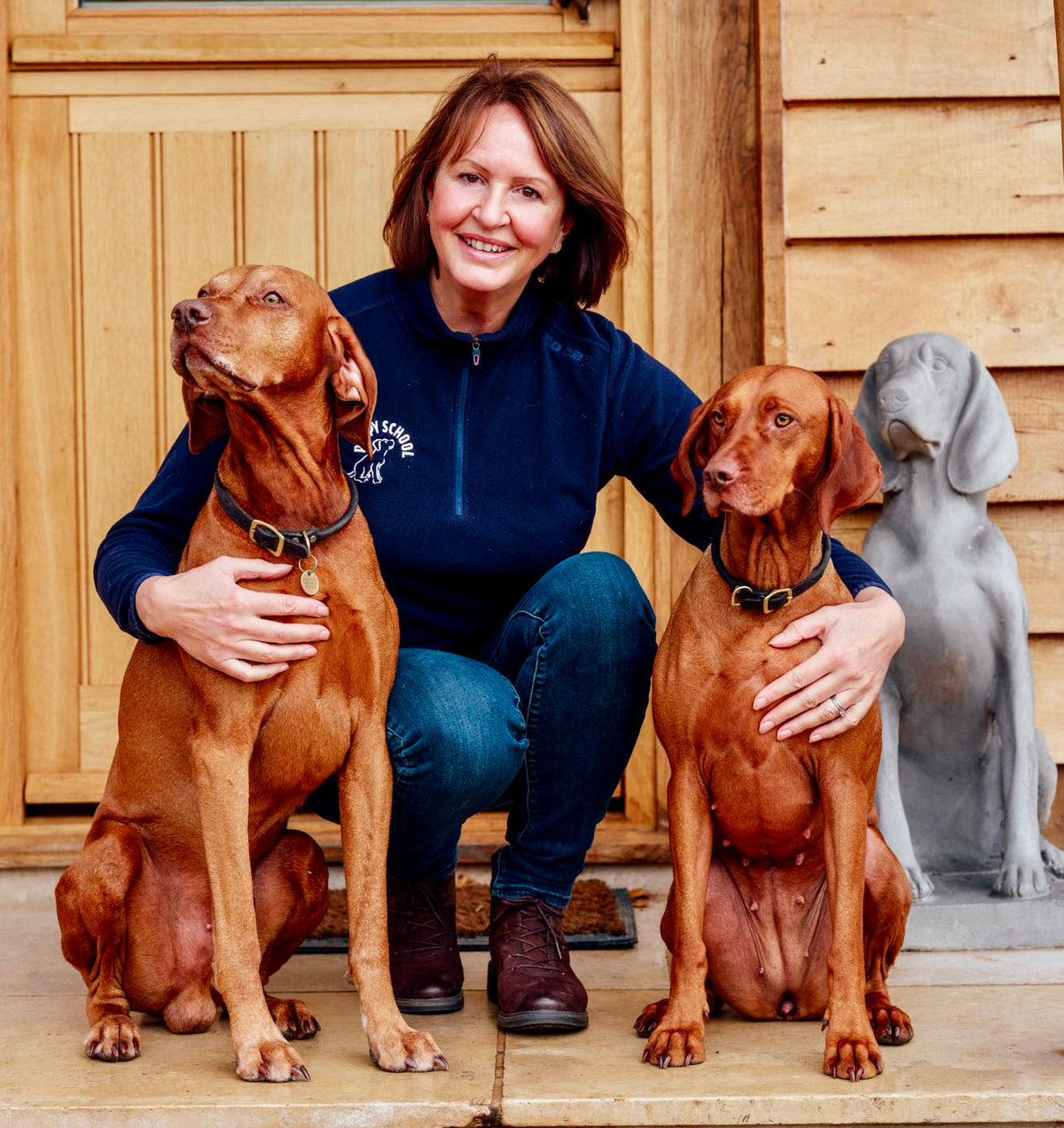
“I’ve trialled CaniNectar on my own dogs, and although they have a balanced raw diet and a relaxed life, I noticed coat changes in both, but particularly in my older dog (9 year old entire male vizsla). Both found the product palatable, even the one who has always been fussy with food, and there has been an unexpected improvement in my older dog’s mouth smell which, despite a lack of tooth tartare or decay, had deteriorated as he aged. To have it brought back to a smell more like that of a younger dog is very beneficial, especially given his habit of getting close and breathing in our faces!” Gwen Bailey, 2026
We met Gwen as a participant in our professional CaniNectar trial. Her knowledge and experience were so impressive that I ordered her book the same week.
Gwen is one of the UK’s most respected dog behaviourists. She was the first full-time Animal Behaviourist appointed by a national welfare charity, spent years as Head of Animal Behaviour at The Blue Cross, founded Puppy School, and wrote The Perfect Puppy, which has sold over 470,000 copies worldwide.
The Natural Dog (Hamlyn, 2021) covers three pillars of canine wellbeing: physical health, dietary health, and mental health. It is written for general readers but grounded in decades of real clinical experience.
The sections that grabbed us were on the gut microbiota. Gwen describes it as “the ecosystem of organisms — consisting of bacteria, fungi, yeasts and other microorganisms — that live in the digestive tract and play an essential role in keeping an animal healthy and happy.” She notes that while canine-specific data is limited, the species and predominance of the canine gut are closely comparable to the human gut.
Gut microbes, she explains, “influence the immune system, protect against opportunistic pathogens, have a role in harvesting nutrients and energy from food, and ferment nondigestible carbohydrates.” Disruption is associated with obesity, diabetes, inflammatory bowel diseases, and autoimmune diseases.
On diversity: “diversity seems to be a generally good indicator of a healthy gut and hence a healthy dog.”
On diet: “Of all the environmental factors studied to date, long-term diet has the biggest effect on the quality and diversity of the human gut microbiota. If we extrapolate this to dogs, choosing the right diet for your dog is of upmost importance.”
On prebiotics and probiotics, Gwen is equally clear. A prebiotic “can only encourage growth of species already present in the gut.”
On probiotics: “Probiotics may be harmful in dogs that have a weakened immune system or a leaky gut so do seek professional veterinary advice before using these supplements.”
Much of the dietary section deals with raw and freshly prepared feeding, and it is here that her gut microbiome argument is strongest. Gwen tracks the move in recent years away from processed convenience food towards fresh, home prepared diets, mirroring the way many owners have changed their own eating. Part of her case for raw and fresh rests on the microbiome. Fresh ingredients carry beneficial microorganisms that add variety to a dog’s gut flora, and she notes that a raw meat based diet has been shown to promote more balanced bacterial growth and greater diversity.
The gut-brain link is the part we found most interesting. Gwen points to serotonin, the hormone involved in regulating mood, and to the finding that germ-free mice produce far less of it than mice with a normal gut flora. Her reasoning is straightforward. If a healthy gut helps make a happy dog, and a healthy microbiota is central to that, then diet is one of the most direct ways an owner can influence it.
She is also clear about what a well-fed gut looks like from the outside. On a raw or freshly prepared diet she lists smaller and firmer stools, little or no flatulence, the near absence of the usual doggy smell, anal glands that empty themselves, cleaner teeth, a healthier coat and a stronger immune system. It is a practical checklist, and one most owners recognise the moment they see the change.
Gwen sets the two approaches side by side in a pair of comparison tables. Among the drawbacks she lists for processed diets is that they do nothing to support the gut microbiota. Against that, she credits raw and freshly prepared feeding with improving microbiota diversity and, through it, strengthening the immune system. That contrast is a large part of why gut health now sits at the centre of the canine nutrition debate.
She ends the section with a sensible caveat. Every dog is an individual, needs change with age, activity and life stage, and variety matters more than any fixed formula. Staying well informed and flexible gives a dog the best chance of thriving.
Where the book meets our own research
Reading The Natural Dog while the results of our own largest trial were coming in was a slightly uncanny experience. The framework Gwen sets out, that a healthier gut makes for a calmer and healthier dog, is close to the one our own data kept pointing back to.
The book's discussion of gut-brain communication aligns with a growing area of canine research. Much of the body's serotonin is produced in the gastrointestinal tract, but serotonin made in the gut does not simply travel to the brain. The gut and brain communicate through neural, immune, endocrine and microbial-metabolite pathways, one of which involves the vagus nerve. Against this scientific background, our two-phase professional field trial involved 129 dogs assessed by 63 UK vets, trainers and behaviourists while receiving CaniNectar.
Her emphasis on microbial diversity fits what we believe is driving that result. CaniNectar’s enzyme rich malt extract helps break food down more completely in the small intestine, so less undigested material reaches the colon to feed the wrong bacteria. In peer reviewed testing, that shifted fermentation towards beneficial short chain fatty acids, with butyric acid up 73.5% and propionic acid up 64.8%. Those are the compounds that sit behind a well functioning gut-brain axis.
Her checklist of what a healthy gut looks like from the outside showed up in the numbers too. In an independent 2025 study with Blue Cross, 80% of dogs reached ideal stool consistency by week four, up from around 42% at the start, and just under a third showed a clinically significant improvement in skin condition. Even the doggy smell she mentions is something we increasingly trace to the gut rather than the coat.
It is worth being precise about what CaniNectar is and is not. Gwen is rightly cautious about probiotics in dogs with a compromised gut, and points out that a prebiotic can only feed the species already present. CaniNectar works differently again, by changing how food is digested rather than adding bacteria to the bowl. One detail worth drawing out is that the calming effect held whether dogs were fed raw, kibble or a mix, which is exactly what you would expect if the benefit comes from supporting the gut itself rather than from any single feeding style. Across four studies covering 259 dogs, no serious adverse events were recorded at any timepoint.
We are careful not to overstate any of this. The professional trial was observational, with no placebo group, and a fully blinded study is the obvious next step. What gives the findings their weight is that the effect repeated independently, in different dogs assessed by different people, and that it lines up with the same gut-brain research Gwen draws on in her book.
"There is so much we have yet to learn about the gut microbiome in dogs and its effects. What we do know is that optimising gut health is important for health and happiness in our dogs as well as us. Caninectar provides a missing link that both optimizes the digestion of any diet while supporting the growth of beneficial bacteria, which is so worthwhile for all dogs, but particularly those that are older, or those fed a suboptimal diet, and those whose gut health has been compromised in some way. The studies on Caninectar’s effect on behaviour are interesting, and it good to see that trials show it brings an improvement, as you might expect given that all animals are so reliant on optimal functioning of their intestines to feel well and contented.” Gwen Bailey, 2026
The Natural Dog is published by Hamlyn. Click here to order
CaniNectar is a complementary feed for dogs developed by Tharos Ltd and made with Enzyme Rich Malt Extract.




Share: