

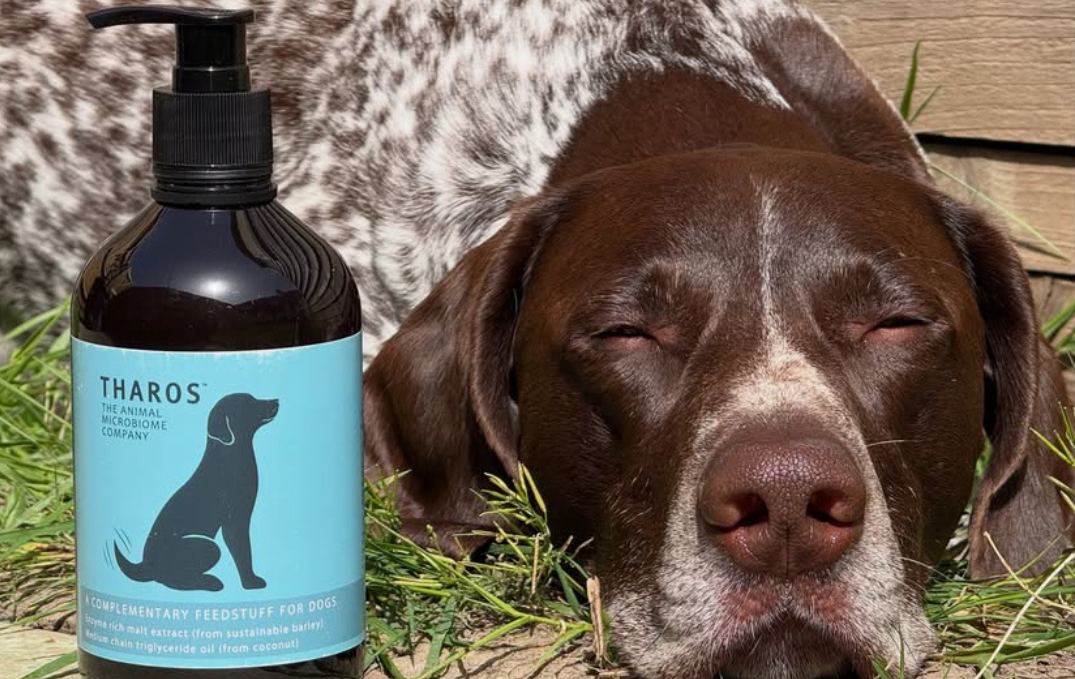
63 UK vets, trainers and behaviourists tracked 129 dogs representing more than 110 breeds and crosses. Of the dogs that began the trial anxious, 38 of 42 improved. Behaviourist Gwen Bailey, founder of Puppy School, participated with her own dogs and has no commercial relationship with Tharos.
A two-phase professional trial of CaniNectar, a natural gut health supplement for dogs, has produced the clearest and most consistent signal yet in Tharos’s research: dogs that entered the trial anxious became measurably calmer. Months later, the same pattern appeared again in a separate group of dogs assessed by different professionals.
Across the two phases, 63 UK veterinary professionals, trainers and behaviourists tracked 129 dogs representing more than 110 distinct breeds and crosses. That gives the study unusual scale and documentation for the category, where supplement trials often involve only eight to twenty dogs and are seldom repeated or published in a form that can be scrutinised.
Anxiety: the most important need
Anxiety remains one of the largest unmet needs in companion animal health. More than 70% of dogs show at least one anxiety-related behaviour, while anxiety and aggression are now cited more often than illness or cost among the reasons owners relinquish their dogs.
Owners have traditionally faced two main options: pharmaceuticals intended to manage symptoms, and calming supplements aimed at neurological pathways. Tharos argues that neither addresses the gut-level drivers it believes can sit upstream of the problem.
“In the last few years, research has made the gut-brain connection in dogs increasingly hard to ignore. The gut isn’t just associated with anxiety in dogs, it appears to be driving it.”
Dr Rosemary Waring, Chief Science Officer, Tharos Ltd
That shift matters commercially as well as scientifically. Owners are increasingly looking for natural products they can use every day, rather than reaching first for a pharmaceutical.
“Owners have begun to realise that what you feed and how your dog digests are significant drivers of behaviour, happiness and wellbeing. They don’t want to reach for medication every time their dog struggles, they want something natural they can give every day and actually feel good about. That’s the gap we’re filling. CaniNectar works on the gut, it’s natural, and the results are there to back it up. I’m excited to see so many of the trial recipients recommending CaniNectar to their clients.”
Ben Nedas, Chief Commercial Officer, Tharos Ltd
The main finding: calmer dogs, twice over
Among dogs that entered the trial with elevated anxiety, professionals recorded a clear reduction within the first few weeks:
- 38 of 42 anxious dogs improved, with only one rated worse.
- Mean anxiety scores fell from 4.29 to 3.23 out of 5, a reduction of about a full point, or roughly 24.7%.
- The result was highly statistically significant (p < 0.0001), with an effect size at the theoretical maximum. Put simply, almost every dog that changed became calmer rather than more anxious.
- Professional confidence in the product rose from 31% in week one to 73% by week four: the longer trained observers watched the dogs, the more convinced they became.
Crucially, the finding was not a one-off. The trial was deliberately divided into two phases, using different dogs and different professionals, to test whether the pattern would hold under fresh conditions. Phase one produced a 1.04-point reduction in anxiety; phase two, conducted independently months later, produced a 1.10-point reduction. Taken together, Tharos calculates the probability of the replicated calming effect arising by chance at roughly 1 in 1.6 million.
Diet did not appear to materially alter the result. Dogs fed raw, kibble and mixed diets became calmer by broadly similar amounts, supporting a mechanism linked to the gut rather than to any one food type.
A familiar name among the assessors
Among the professionals taking part was Gwen Bailey, one of the UK’s best-known canine behaviourists. Bailey was the first full-time animal behaviourist appointed by a national welfare charity, later served as Head of Animal Behaviour at Blue Cross, founded the Puppy School network and wrote The Perfect Puppy, which has sold more than 470,000 copies worldwide. She has no commercial relationship with Tharos.
Bailey tested CaniNectar on her own two dogs, both of which are fed a balanced raw diet.
“I’ve trialled CaniNectar on my own dogs, and although they have a balanced raw diet and a relaxed life, I noticed coat changes in both, but particularly in my older dog (a nine year old entire male vizsla). Both found the product palatable, even the one who has always been fussy with food, and there has been an unexpected improvement in my older dog’s mouth smell which, despite a lack of tooth tartar or decay, had deteriorated as he aged. To have it brought back to a smell more like that of a younger dog is very beneficial, especially given his habit of getting close and breathing in our faces.”
Gwen Bailey, canine behaviourist and founder of Puppy School
Bailey has written extensively about the canine gut microbiome in The Natural Dog, where she is notably cautious about probiotics for dogs with a compromised gut. CaniNectar takes a different route: it changes how food is broken down rather than adding bacteria to the bowl.
More than behaviour
A separate clinical trial run with Blue Cross in 2025 followed 25 rescue dogs for four weeks and recorded improvements across several additional measures:
- 80% of dogs reached ideal stool consistency by week four, up from 41.7% at the start.
- A 33% reduction in noise reactivity.
- 29.2% of dogs showed a clinically significant improvement in skin condition.
- The proportion of dogs rated as having excellent focus rose from 4.2% to 20.8%.
- A 96% completion rate, with zero adverse events.
Across both the professional trial and the Blue Cross study, there were no serious adverse events at any timepoint. None of the 129 dogs in the professional trial withdrew.
Older dogs
Older dogs are another underserved group. Subclinical B12 insufficiency is common in aging dogs and has been reported in up to 82% of dogs with chronic enteropathies. Its signs can be easy to miss, appearing as reduced energy, a flatter appetite or less engagement.
“Owners aren’t necessarily asking for an anti-ageing product. They’re asking why their dog seems flatter than it used to, and that’s a need the category can speak to directly.”
Dr Rosemary Waring
The settling-in period
Around one dog in twenty passed looser or softer stools during the first few days to a week. Tharos considers this a temporary consequence of changing fermentation in the gut. In every case where follow-up data were available, the effect was mild and resolved on its own, usually within the first week.
Feedback from the professionals
Around nine in ten dogs were assessed by their own guardians, who were themselves behaviourists, trainers or veterinary professionals. That combined a trained, critical eye with day-to-day familiarity with each dog.
“He seems much calmer, and I have started allowing him out of the crate when I am not home. His anxiety seems to have decreased.”
Connie, veterinary nurse, on Norman, a German Shorthaired Pointer, week one
“Much calmer overall. More confident with dogs and less reactive to sounds.”
Caroline Mappouridis, trainer
“Calmer, more settled, ignoring triggers, and sleeping significantly better.”
Phoebe Marker-Fairweather, trainer
“Seems happier. Less stressed by dogs, even able to engage when they approach.”
Lyndsey Moreton, trainer
“Didn’t get to the highest level of anxiety as before.”
Behaviourist, on a greyhound prone to thunderstorm panic. Not a cure, but a softening of a hard ceiling.
“Much better stool quality and reduced wind. Really impressed with this product.”
Ann Hotston RVN, on Bear, a Shar Pei
“Coat shine improved, and it is the first product to ever reduce her obsessive paw licking.”
Corinne Waite, behaviourist
“As of day 30 his coat has become much softer and shinier.”
Rachel Harriett
Why it works
Tharos describes its approach as anabiomics, a term defined by Waring, Dagi and Hunter in a 2024 peer-reviewed paper. The key distinction is where intervention begins. Probiotics and postbiotics act downstream, either by introducing foreign bacterial strains or supplying compounds those bacteria would otherwise produce. Anabiomics starts further upstream, with digestion.
“Neither approach asks why the microbiome became dysbiotic in the first place. The goal is to restore the conditions under which an animal’s own beneficial bacteria naturally thrive, without introducing any foreign organisms at all.”
Dr Rosemary Waring
In practice, enzymes in CaniNectar’s malt extract help break food down more completely in the small intestine, reducing the amount of undigested material reaching the colon and the substrate available to less desirable bacteria. This shifts fermentation towards beneficial short-chain fatty acids, compounds that support the gut wall and participate in gut-brain signalling, including pathways involving the vagus nerve.
The behavioural hypothesis follows from those gut-brain pathways. Around 90–95% of the body’s serotonin is produced in the gut rather than the brain. B vitamins made more available through digestion, particularly B6, are also cofactors in serotonin and GABA pathways. Together, these mechanisms may help explain why professionals often reported behavioural changes within three to six days, before a longer-term microbiome shift would be expected to take hold.
The two-year follow-up
Six UK Border Force working dogs were followed for two years after supplementation. Spirochaete levels had fallen by an average of 96.8%, and that reduction was still maintained at the two-year follow-up, with no pathogen expansion detected at any point.
“What that produces is a self-sustaining shift driven by the animal’s own flora. That kind of durability is simply not what the probiotic literature tends to show.”
Dr Rosemary Waring
Assessing the evidence
Tharos is explicit about the limits of the evidence. This was an observational study: professionals knew which dogs were receiving the product, and there was no placebo group. The design therefore cannot fully separate the effect of CaniNectar from other influences. CaniNectar is a supplement, not a medicine, and is not a substitute for veterinary care or behavioural work.
The strength of the signal, the company argues, lies in replication: the same pattern appeared twice, in different dogs assessed by different observers, and is consistent with published research on the gut-brain axis. The stated next step is a randomised, blinded study.
“What makes this stand out is not any single number, but that the calming effect appeared twice, in different dogs assessed by different people, months apart. Replication is what separates a real signal from a lucky one. I want to be clear that this was an observational trial, so the strongest claims have to wait for a randomised, blinded study. Even so, several separate pieces of research now point the same way, and that is not something you see often in this field.”
Dr Rosemary Waring, Chief Science Officer, Tharos Ltd
Notes to editors
About CaniNectar
CaniNectar is a natural daily gut health supplement for dogs made by Tharos Ltd. It is produced from malted barley, using heritage varieties selected for their naturally high enzyme content, and combines those enzymes with a full range of B vitamins, natural antioxidants and minerals including magnesium, potassium, selenium, zinc and iron. The liquid is added to food at 0.7 ml per kg of body weight. It contains no synthetic additives and introduces no foreign organisms. CaniNectar reached the canine market after several years of research in horses.
A note on malt extract's history
Malt has a long history of use as a remedy, but that history has two distinct strands. CaniNectar sits firmly in the second.
The first is malt as a nourishing tonic. For well over a century it was used in convalescent medicine for the weak, the ill and the young. Its value came from malt as a food: digestible carbohydrate, B vitamins and minerals. Much of the malt extract of the period was boiled or heat-concentrated, destroying its delicate enzymes, so the benefit was nutritional rather than enzymatic.
The second is malt as a source of digestive enzymes. Malt’s starch-splitting enzymes were first isolated in the 1830s; the challenge has always been preserving them in a finished product because heat destroys them. That is the strand relevant to CaniNectar. Its enzyme-rich malt extract is produced at low temperature to retain a broad profile of active enzymes, while Tharos adds a modern mechanistic explanation for how those enzymes can reshape the gut environment and microbiome. The formulation is protected by a granted US patent, with its use in dogs the subject of a pending European application (see Intellectual property, below).
About anabiomics
Waring, Dagi and Hunter defined anabiomics in the Journal of Modern Agriculture and Biotechnology in 2024 as an approach to restoring a healthy gut microbiome without introducing foreign microorganisms. It differs from probiotics, which add bacteria, and prebiotics, which feed species already present.
Intellectual property
CaniNectar's enzyme-rich malt extract formulation is protected by a granted US patent (inventors Hunter and Waring). Its specific application in dogs is the subject of a separate patent application, published by the European Patent Office in October 2025 and currently under examination (inventors Waring and Nedas).
The evidence base
| Study | Dogs | Duration | Primary finding |
|---|---|---|---|
| UK Professional Trial, Phases 1 and 2 (2025 to 2026) | 129 | 5+ wks per phase | Anxiety fell by about one point among dogs that began anxious (p < 0.0001), with the finding replicated across two independent phases. Zero serious adverse events; zero withdrawals. |
| Blue Cross independent clinical trial (2025) | 25 | 4 wks | 80% reached ideal stool consistency by week four, up from 41.7%. Noise reactivity fell 33%; 29.2% showed clinically significant skin improvement. 96% completion. |
| UK Border Force working dogs, with two-year follow-up (2023) | 6 | 8 wks, plus 2 yr | Spirochaetes fell by an average of 96.8%, with the reduction maintained at two years. Faecalibacterium prausnitzii normalised across all six dogs. No pathogen expansion at any timepoint. |
| Waring, Dagi and Hunter, Journal of Modern Agriculture and Biotechnology (2024) | n/a | 8 wks | Peer-reviewed paper defining anabiomics. Metabolomics and metagenomics showed a shift in gut fermentation towards beneficial short-chain fatty acids and fewer putrefactive by-products. |
The 2024 Waring, Dagi and Hunter paper is a multi-species mechanism study rather than a canine outcome trial, and is cited here for mechanism only.
Recent coverage
Petfood Industry, “Expert perspective: anabiomics as a new direction in animal gut health”, by Lindsay Beaton, 7 August 2026. An interview with Dr Rosemary Waring on the anabiomics category and its application to anxiety and ageing in dogs.
About Gwen Bailey
Gwen Bailey is a canine behaviourist and the founder and director of Puppy School, a UK-wide network of around 120 tutors that has worked with more than 100,000 puppies and their owners since 2002. She is the author of The Perfect Puppy and The Natural Dog. Bailey participated in the CaniNectar professional trial with her own dogs and has no commercial relationship with Tharos. She previously served as Head of Animal Behaviour at Blue Cross; that tenure predates and is unconnected to the independent Blue Cross clinical trial cited above.
About Tharos Ltd
Tharos Ltd is a UK animal health company producing enzyme-rich malt extract supplements for dogs, horses and poultry. Its equine product, EquiNectar, has an evidence base spanning six independent studies over eleven years.
Available to media
Available to media: interviews with the trial team, including Chief Science Officer Dr Rosemary Waring; full trial data; the supporting science deck; product imagery and samples. Introductions to participating professionals can also be arranged, subject to their consent.
Media contact
Tharos Ltd, 34 High Street, Aldridge, Walsall, WS9 8LZ, United Kingdom. Full trial write-up available at caninectar.com. Email: info@tharos.co.uk


Share:
The Natural Dog by Gwen Bailey: Lessons on Canine Gut Health
Jessie, Bliss & Lucky Leo's Story