

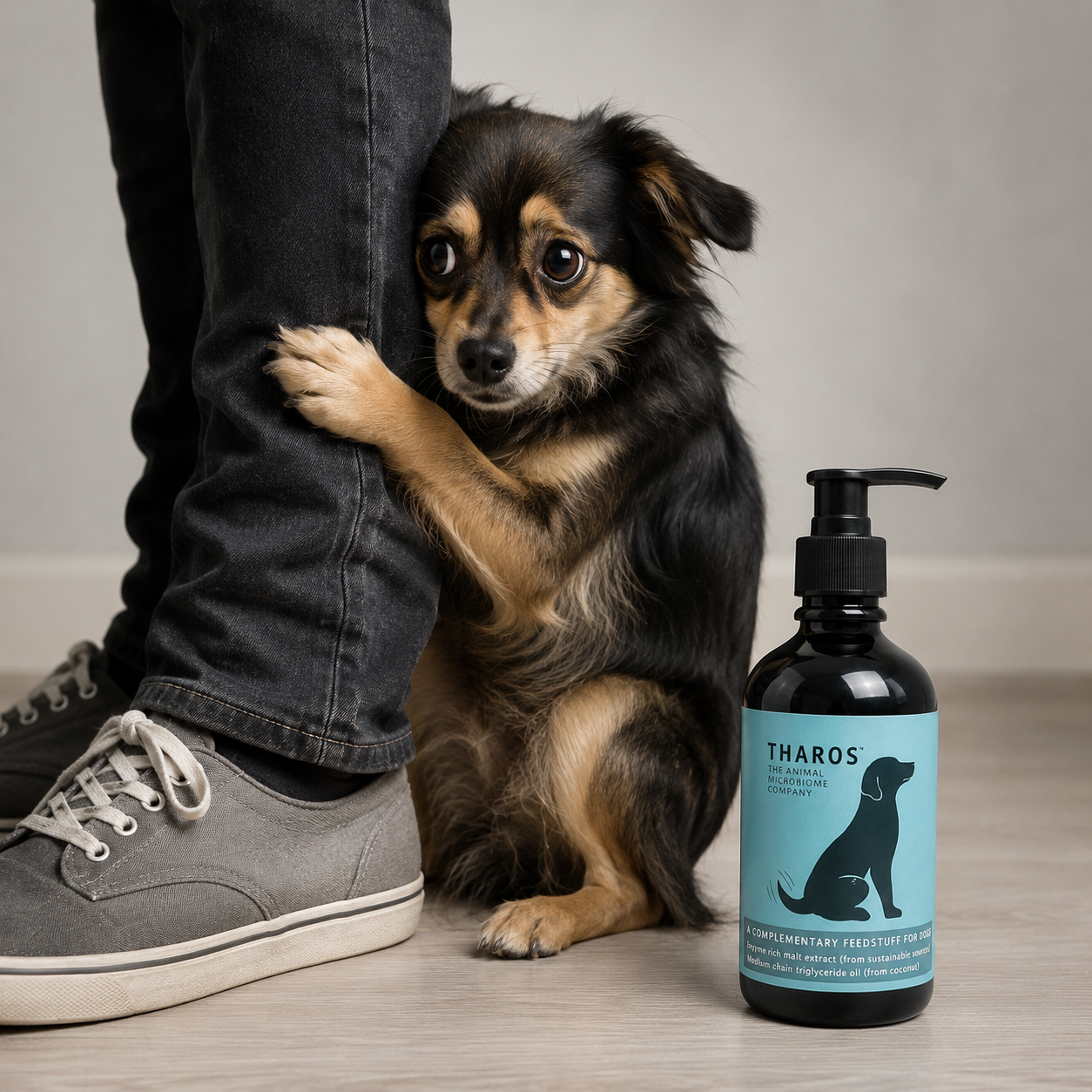
Does your dog follow you from room to room? Wait outside the bathroom? Refuse to settle unless they are physically pressed against you? You might be living with what owners and behaviourists call a "velcro dog", and whilst the devotion can feel flattering, the science increasingly suggests it is a sign that something deeper is going on.
What Is a Velcro Dog?
A velcro dog is not simply affectionate. They are a dog whose anxiety makes separation from their owner feel genuinely unbearable. They shadow your every move, become visibly distressed the moment you disappear from view, and struggle to self-settle even in the safest of environments.
The behaviours associated with this are well documented. The Lincoln Canine Anxiety Scale identifies owner-seeking behaviour, restlessness and pacing, hypervigilance, panting, and compulsive behaviours such as obsessive licking as hallmarks of canine anxiety.[1] An estimated 72.5% of dogs show anxiety-like behaviours to some degree.[1] The consequences are serious - dogs living with chronic anxiety tend to experience poorer health outcomes, reduced lifespans, and significantly diminished welfare.[1] For owners, the emotional and practical toll is real too, often straining the very bond that makes dog ownership so rewarding.
Yet despite how widespread it is, canine anxiety is frequently underestimated in clinical practice.[1] It tends to be framed as a training problem - something to be managed through behavioural intervention alone. But a growing body of scientific evidence points to a biological dimension that has long been overlooked: the gut.

The Gut Is Talking to the Brain…and Your Dog's Behaviour Is the Result
The gut-brain axis is a bidirectional communication network linking the gastrointestinal tract and the central nervous system through metabolic, neural, endocrine, and immune-mediated pathways.[1], [2], [3] The microorganisms living in your dog's intestines - the gut microbiome - are not passive passengers. They are active contributors to mood, stress reactivity, and behaviour.
In a healthy dog, the gut microbiome is dominated by members of Bacteroidetes, Fusobacteria, and Firmicutes, with smaller populations of Actinobacteria and Proteobacteria.[1], [3] This community regulates immune function, energy metabolism, and, critically, the production of neurotransmitters that govern how your dog feels and behaves.
Serotonin is perhaps the most striking example. More than 90% of the body's total serotonin is produced in the gut by enterochromaffin cells and enteric neurons, and gut microbiota directly regulate the metabolic pathways involved in its synthesis.[1], [2] Serotonin plays a crucial role in mood, sleep, cognition, social interaction, and anxiety regulation.[3] Studies have found significantly lower serotonin concentrations in dogs displaying aggressive and anxiety-driven behaviours compared to non-anxious individuals.[3]
Dopamine, essential for motivation and reward, is similarly shaped by the gut - more than 50% of the body's dopamine is produced in the gastrointestinal tract, with gut microbiota playing a key role in its regulation.[3] GABA, the brain's primary inhibitory neurotransmitter, is produced by a broad range of gut bacteria, and its modulation through the microbiome has been shown to reduce anxiety-related behaviours and lower cortisol levels in dogs.[3] Disruptions to GABA signalling are directly linked to inappropriate fear responses and emotional dysregulation.[1]
Beyond individual neurotransmitters, the microbiome produces short-chain fatty acids (SCFAs) - particularly butyrate, acetate, and propionate - through the fermentation of dietary fibre. These compounds maintain the integrity of the intestinal barrier, cross the blood-brain barrier, modulate immune responses, and have been shown to attenuate the cortisol response to acute stress.[1], [2] Reduced diversity in SCFA-producing bacteria has been observed in individuals with generalised anxiety disorders, suggesting a direct link between gut metabolite production and psychological resilience.[1]
The hypothalamic-pituitary-adrenal (HPA) axis, the body's central stress-response system, provides the final piece of this picture. Chronic anxiety activates the HPA axis, elevating cortisol and altering gut microbiome composition. In turn, a disrupted gut can reactivate the HPA axis, creating a self-reinforcing cycle of stress and dysbiosis.[1], [2], [3] For a velcro dog living in a persistent state of low-level anxiety, this cycle can become deeply entrenched over time.
What the Research Actually Shows in Dogs
Several studies have now examined whether gut microbiome composition differs between dogs with and without behavioural disorders - and the findings are compelling, if still emerging.
Research has found that dogs with aggressive or phobic behavioural disorders display distinct gut microbiome profiles compared to behaviourally healthy individuals.[3] Phobic dogs, for instance, showed a higher abundance of Lactobacillus, a genus well known for its role in GABA production.[3] Anxious dogs assessed using the validated C-BARQ questionnaire demonstrated greater microbial diversity than non-anxious dogs, with specific taxa including Blautia and members of the Oscillospirales associated with higher anxiety scores.[2] One pilot study found that fearful dogs had reduced serum levels of key neurotransmitter precursors, including glutamine and glycine, alongside shifts in microbial composition - suggesting a potential mechanistic connection between gut microbiota and emotional behaviour.[2]
A 2025 critical review of the available research concluded that preliminary evidence links gut microbiota composition in dogs to anxiety, stress responses, and cognitive performance, and called for comprehensive, standardised longitudinal research to further elucidate these relationships.[2] A separate 2024 review emphasised that the gut microbiome can influence the canine central nervous system through the vagus nerve, neurotransmitter regulation, SCFA production, and HPA axis modulation, all pathways directly relevant to anxiety and the kind of persistent hyper-attachment we see in velcro dogs.[3]
The research is still maturing, and scientists are careful to distinguish correlation from causation. But the direction of evidence is consistent: gut health and behavioural health in dogs are deeply intertwined.
How CaniNectar Supports the Gut-Brain Connection
CaniNectar is made from malted barley, using ancient artisan barley varieties valued across Europe for over 800 years for their naturally high enzyme content. Produced via a patented process that preserves these enzymes, each dose delivers a broad spectrum of naturally occurring digestive enzymes - including protease, lipase, amylase, fructanase, cellulase, xylanase, beta-glucanase, and phytase - alongside essential B vitamins, powerful antioxidants including ferulic acid and flavan-3-ols, and key minerals such as magnesium, zinc, selenium, and iron.[5]
These components work together to support more efficient digestion, improve nutrient absorption, and create the conditions in which a healthy, balanced gut microbiome can thrive. In the context of the gut-brain axis science outlined above, this matters enormously. A gut that digests more effectively, maintains its barrier integrity, and supports healthy microbial diversity is a gut better positioned to regulate the neurotransmitters and metabolites that influence your dog's emotional life.
As of May 2026, CaniNectar's ongoing UK professional trial (launched in April 2026) has enrolled 47 animal health professionals, including trainers, behaviourists, vets, vet nurses, and hydrotherapists, assessing 81 dogs across 212 weekly evaluations, with 91% protocol compliance recorded to date.[4]
The results were remarkable. Professional confidence in the product shifted substantially across the trial period, with the proportion of professionals rating their confidence at 4 or 5 out of 5 increasing significantly week on week (Kruskal-Wallis p = 0.001; Week 4 vs Week 1 p < 0.0001). Mean overall impression rose from 5.8 to 7.97 out of 10.[4] In dogs assessed as highly anxious, the anxiety reduction effect size reached r = 0.98, approaching the theoretical maximum, with a significance of p < 0.0001.[4] At the trial's conclusion, every single professional at wrap-up (13 of 13) said they would recommend CaniNectar to their clients. There were zero serious adverse events across all 212 submissions.[4]
One behaviourist working with an English Springer Spaniel noted that obsessive paw licking - a classic anxiety-driven compulsive behaviour - had never responded to any product they had previously tried. After eight weeks on CaniNectar, they observed a reduction for the first time.[4]
Metabolic analysis from the trial brought the gut-brain connection into sharp relief. Dogs using CaniNectar showed a 73.5% increase in butyric acid, a beneficial SCFA of precisely the type linked in the research literature to intestinal barrier integrity, reduced cortisol reactivity, and improved brain function. This was accompanied by a 32.6% reduction in methanol, a toxic metabolite, and a 21.7% reduction in ammonia, a marker of putrefactive processes in the gut.[4] These are not incidental findings. They represent measurable, meaningful improvements in the gut environment, the same environment from which your dog's mood, resilience, and behaviour emerge.

Your Velcro Dog Deserves More Than Behaviour Work Alone
If your dog cannot bear to be without you, please do not dismiss it as a personality quirk or a training failure. It is a welfare issue, and the gut may be both a cause and a key to recovery.
The science linking gut microbiome health to anxiety, neurotransmitter regulation, and stress resilience in dogs is no longer fringe. It is published in leading peer-reviewed journals, backed by multiple research groups, and now supported by professional trial data showing real-world results. Supporting your dog's gut is not a replacement for behavioural support, it is the foundation that may make that support finally work.
A calmer gut. A calmer dog. And maybe, just maybe, a dog who can finally settle when you leave the room.
References
- Sacoor, C., Marugg, J. D., Lima, N. R., Empadinhas, N., & Montezinho, L. (2024). Gut-brain axis impact on canine anxiety disorders: New challenges for behavioral veterinary medicine. Veterinary Medicine International, 2024, Article 2856759. https://doi.org/10.1155/2024/2856759
- Crisante, A., Newberry, F., Clegg, S. R., Mitchell, G. L., Pike, T. W., Ratcliffe, V., Spain, A., Wilkinson, A., Zulch, H., & Mills, D. S. (2025). A critical review of research concerning the gut microbiome in dogs and its relationship with behaviour. Applied Animal Behaviour Science, 292, Article 106755. https://doi.org/10.1016/j.applanim.2025.106755
- Kiełbik, P., & Witkowska-Piłaszewicz, O. (2024). The relationship between canine behavioral disorders and gut microbiome and future therapeutic perspectives. Animals, 14(14), Article 2048. https://doi.org/10.3390/ani14142048
- Tharos Ltd. (2026). CaniNectar UK professional trial results: April 2026 [Unpublished trial data]. Tharos Ltd.
- CaniNectar. (2026). Product information. Tharos Ltd. https://caninectar.com/


Share:
Maggie's Story
From Gut to Grin: Why Your Dog's Breath Starts in Their Belly